
Affiliate disclosure: This post contains paid links. As an Amazon Associate I earn from qualifying purchases.
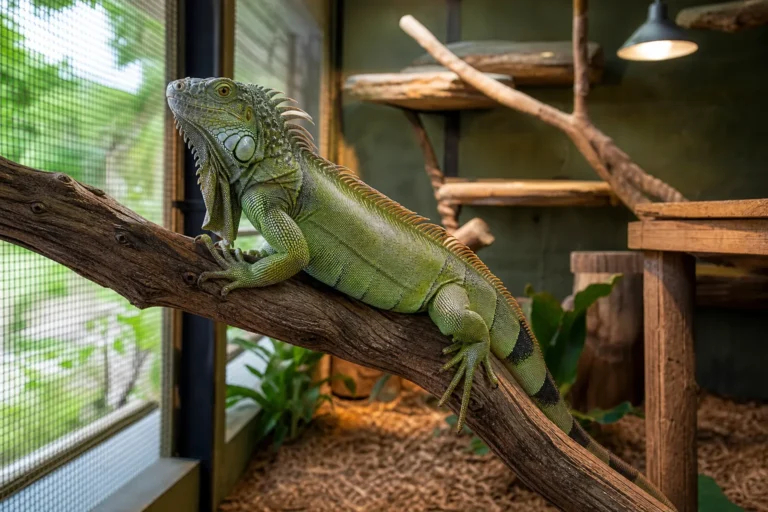
A proper cage for a green iguana needs more than floor space. Plan for climbing, a temperature gradient, UVB lighting, humidity and daily cleaning. This guide focuses on green iguanas; other species can have different requirements.

1. Plan For Adult Size
A small cage does not keep an iguana small. Adults need a large enclosure with room to turn, climb and stretch out. Prepare the next enclosure before your animal outgrows its current home. Read our iguana care guide for more background.
Anchor substantial branches and platforms securely. Choose supports for the animal’s current weight and future growth; small decorative vines cannot support an adult iguana. Keep the floor easy to clean and provide ventilation.
2. Measure And Control Temperature
Create a warm basking area and a cooler retreat. Zoo Med’s green iguana guide lists daytime air temperatures of 80–85°F, a basking spot of 95–100°F and nighttime temperatures of 75–80°F. Confirm a suitable setup with a reptile veterinarian and measure the actual conditions rather than relying on the thermostat setting.
Monitor warm and cool areas separately. A Zoo Med Digital Thermometer and Humidity Gauge (paid link) can help track conditions; additional temperature probes are needed to compare zones. Secure probes where the animal spends time and keep cords out of reach.
Use a thermostat compatible with the heater. The Zoo Med ReptiTemp Dimming Thermostat (paid link) is designed for dimmable heat sources. Follow its load limits and the heater’s instructions. Do not put fluorescent UVB lamps on a dimming thermostat. Guard hot equipment against contact and avoid heat rocks.
3. Maintain Humidity And Fresh Water
Use a hygrometer to check humidity instead of guessing. Merck lists 60–85% for green iguanas; enclosure conditions should be reviewed for your animal. Maintain ventilation and clean drinking water. Humidity does not replace access to water.
If manual misting does not meet your setup’s needs, a Zoo Med ReptiRain habitat mister (paid link) is an option. Adjust it using measured humidity, keep the reservoir and nozzles clean, and avoid leaving the enclosure constantly waterlogged.
4. Provide UVB Every Day
Indoor green iguanas need appropriate UVB lighting, not just a warm bulb or visible light. You can compare Zoo Med ReptiSun T5 HO UVB fixtures on Amazon (paid link). Choose lamp output, fixture length and basking distance for the enclosure, accounting for any mesh between the lamp and animal. Follow the manufacturer’s installation and replacement instructions.
Provide shaded areas as well as a basking zone. Glass blocks useful UVB, so a sunny window is not a substitute. Use a day/night lighting schedule; Zoo Med recommends 10–12 hours of UVB daily.
Care references: Zoo Med: Green Iguana; Merck Veterinary Manual: reptile husbandry; VCA: Iguana Housing. Updated October 20, 2026.