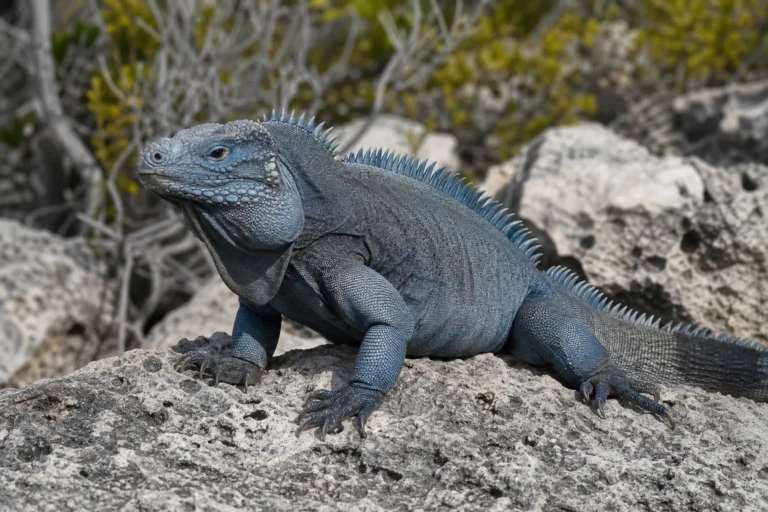

Rhinoceros iguanas and green iguanas invite comparison, but a useful identification guide needs evidence about both animals. The verified source available here describes the green iguana in Florida; it does not provide a species-specific account of the rhinoceros iguana. This guide explains what that source supports, how to observe a green iguana, and where the comparison must stop.
Start With A Scientific Name
The green iguana’s scientific name is Iguana iguana. A scientific name identifies the animal discussed in a source more precisely than a color-based common name. That matters here because the verified Florida account describes green iguanas in several colors, not just green. The source does not supply a scientific name or classification for the rhinoceros iguana, so it cannot establish how the two are related. For an additional introduction to the animal covered by the source, see our green iguana page.
Do Not Rely On Color Alone
Young green iguanas are particularly bright green, but adults can be bold or dull green, olive, brown, or brownish-gray. Males in breeding condition may even be orange. The also notes that green iguanas tend to darken in cool weather. A color description is therefore a useful observation, not a conclusive identification. Record the shade you see, then look for the animal’s shape and other features rather than assuming that a brown or orange iguana cannot be a green iguana.
Look At The Jaw And Throat
Both male and female green iguanas have a dewlap, a flap of skin hanging from the lower jaw. They also have a large, round scale at the rear of the jaw. These features are useful to note when examining a clear photograph or watching an animal from a suitable distance. The verified account identifies them as green iguana features; it does not establish whether they are present or absent in rhinoceros iguanas. Use them as part of a description, not as a standalone test between the two species.

Notice The Crest And Tail
Green iguanas have a row of spike-like scales along the neck, back, and part of the tail. These scales are typically longer in mature males than in females. Green iguanas also have long tails and relatively short legs, with long toes and sharp claws for climbing. When comparing photographs, try to see more than the head: a view of the back and tail adds useful context. Remember that the verified source does not describe a rhinoceros iguana’s crest or tail for comparison.
Put Size In Context
The Florida account reports that male green iguanas can grow to more than 6 feet in total length, while females can reach just over 5 feet. The tail can account for as much as three quarters of total length. A long tail therefore makes an important difference when interpreting a measurement or photograph. Note whether a stated length includes the tail before comparing figures. The available excerpt gives no corresponding rhinoceros iguana measurement, so it does not support a size ranking between the two.
Separate Native Range From Florida Sightings
The verified publication describes green iguanas as introduced and established in Florida. That is a statement about their status in Florida, not a map of their native range. The excerpt does not specify the native range of either the green iguana or the rhinoceros iguana, so a native-range comparison would require additional species-specific sources. A sighting location can still be useful in an identification record: note where the animal was observed, but do not treat a Florida sighting as evidence that the species originated there.
Consider Other Similar Iguanas
In Florida, the source identifies another potential lookalike: the introduced black spiny-tailed iguana, Ctenosaura similis. It is established in many of the same areas as the green iguana, including parts of the southern Gulf and Atlantic coasts and some Florida Keys. The source says the two have similar body plans, but black spiny-tailed iguanas are shorter and have shorter back spines. This comparison is useful in Florida; it should not be mistaken for evidence about the rhinoceros iguana.
Know When The Comparison Needs More Evidence
A reliable side-by-side guide would need verified information on the rhinoceros iguana’s taxonomy, native range, appearance, and natural history, as well as native-range information for the green iguana. Those details are not in the supplied excerpt. Our rhinoceros iguana page is a starting point for further reading, but the verified source used here cannot confirm its species-specific details. Until both species are supported by suitable sources, keep observations separate from conclusions about their differences.
The Takeaway
For green iguanas, look beyond color to the dewlap, round jaw scale, back spines, legs, and long tail. Record location and measurement context too. A full comparison with the rhinoceros iguana remains an open research task, not a conclusion supported by this source alone.
Sources And Further Reading
THE JUNGLE SUPPLY EDIT
Shop This Article
Related Finds For Learning And Responsible Captive Care

Rite In The Rain Notebooks · 3 Pack
Weatherproof notebooks for temperature logs and daily care observations.
Use for records to discuss with your reptile veterinarian when needed.
View On Amazon (opens in a new tab)
Govee H5075 Bluetooth Hygrometer
A connected temperature and humidity meter for tracking conditions.
Check the listing’s pack size; protect this indoor unit from water.
View On Amazon (opens in a new tab)
Zoo Med ReptiTemp Infrared Thermometer
Quick surface spot checks on basking branches and platforms.
Measures surfaces, not air temperature. Follow the distance guidance.
View On Amazon (opens in a new tab)
Etekcity Stainless Steel Kitchen Scale
A digital scale for measuring meal ingredients and tracking portions.
Check capacity and platform size; it is not suitable for weighing every reptile.
View On Amazon (opens in a new tab)Compare sizes, compatibility and current availability on Amazon. Choose what fits your existing setup.
As an Amazon Associate I earn from qualifying purchases.